
Harper County Release Date Types
“Anticipated release date” is KDOC's official field phrase. It is a calculated date for a person in the Kansas corrections system, not a promise that the person will leave on that day. An actual release date records a movement that already occurred. A parole-eligibility date marks when an eligible case may reach board review. A court hearing date concerns legal proceedings and should never be relabeled as a jail exit date.
County detention is different. Someone awaiting trial may leave after bond, a court order, dismissal, or another legal event, so no fixed release day may exist in advance. A short county sentence can involve jail credit and local rules, but Harper County publishes no online calculator or date field. Ask the jail records function for its actual calculation and compare it with the court's journal entry.
| Date or event | What it means | Best source |
|---|---|---|
| Anticipated release | KDOC's current calculated estimate | KASPER detail and KDOC |
| Parole eligibility | Possible board-review point for an eligible sentence | Sentence, statute, and Prisoner Review Board calendar |
| Actual release | Recorded movement out of the holding agency | Jail release record or KDOC movement |
| Discharge | End of the supervision relationship shown in that system | KASPER or court discharge record |
Lookup Harper County Release Dates
Start with custody, not the offense county. KASPER does not include every person booked into the Harper County Jail. Kansas VINE covers adult county-jail custody but expressly excludes KDOC prisoners in state facilities. A transfer from the jail to KDOC is also not a community release. Choosing the wrong system can turn a no-result into a false conclusion.
- Determine whether the person is in the Harper County Jail, a KDOC facility, another county jail, or federal custody.
- For local custody, call the Sheriff's Office at 620-842-5135 and ask whether a scheduled date exists. Request the final release record after movement.
- Open the Harper County District Court case. Read the journal entry for sentence length, jail credit, consecutive or concurrent terms, probation, and later orders.
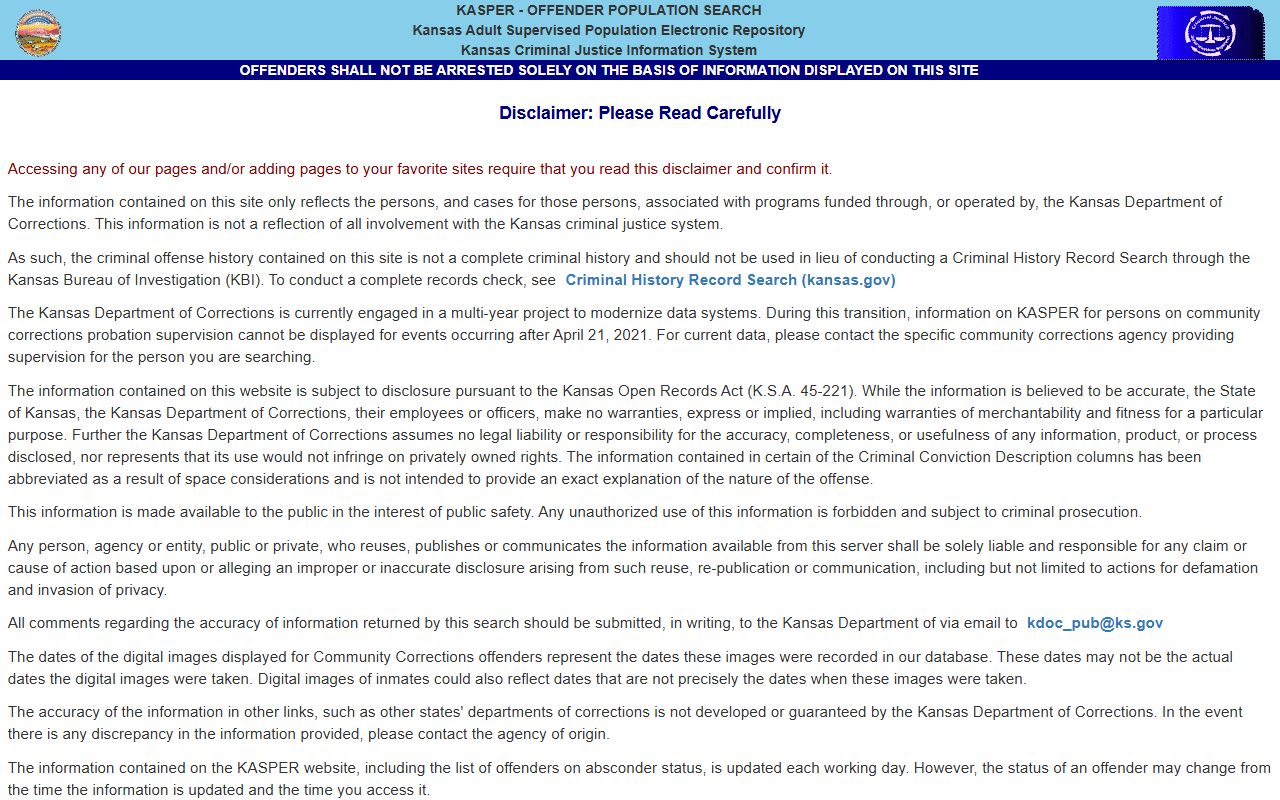
- For KDOC custody, begin at the KASPER disclaimer and search. Use a KDOC number when known and match the result carefully.
- Record the exact label, anticipated date, access date, facility or supervising location, county, and case number. Do not convert a projected date into an actual release.
- After the date passes, verify the movement through KASPER, the jail release record, or the receiving agency if the event was a transfer.
The Harper County court record and the custody record answer different parts of the question. The judge's order controls the sentence imposed. Jail or KDOC records show how that order was administered and when the person physically moved. If the two appear inconsistent, ask the record owner to explain its own field rather than calculating a date from incomplete public data.
Note: A “released” county record may describe delivery to another agency, so always request the release type and destination.
Harper County KASPER Date Field
KASPER, the Kansas Adult Supervised Population Electronic Repository, covers adults who have been in KDOC custody or supervision. It is not a statewide county-booking index. A person with only a Harper County misdemeanor jail stay may never appear. Someone convicted in Harper County may be housed anywhere in the Kansas system and should be found by name or KDOC number rather than by searching for a local prison.
KDOC says the public record may show conviction information, county and case number, custody or supervision level, and an anticipated release date. The KDOC locating explanation describes that anticipated-date field.

The field is useful for a state-prison timeline, but it remains calculated information and must be paired with the exact status and later movement record.
The search also includes statuses such as Discharged and Discharged-Deceased. Parole or postrelease means the person has left the prison institution for supervision, not that KDOC involvement has ended. Discharged is the stronger endpoint within that repository. KASPER updates each working day, so it cannot provide minute-by-minute confirmation.
The KASPER search interface demonstrates the status choices used to narrow a state record.
A saved result should include its access date because status, anticipated release information, and supervising location may change on a later working-day update.
Harper County Good-Time Calculation
Kansas good time can move the prison-release calculation, but the familiar “85 percent” shorthand is not a universal automatic release rule. For many crimes committed on or after July 1, 1993, the phrase comes from a statutory ceiling of up to 15 percent good-time credit against the prison part of a sentence. K.S.A. 21-6821 contains different rules and exceptions based on offense date, severity, and sentence type.
The statute also permits a separate program credit of up to 120 days in eligible circumstances. Credits can be forfeited. Offense-specific provisions, sentence aggregation, consecutive terms, disciplinary action, and compliance with an approved release plan can alter what KASPER displays. Some serious offenses carry narrower credit rules. Older indeterminate sentences follow parole-eligibility structures rather than the same simple percentage model.
KDOC regulations govern award, withholding, forfeiture, and restoration details. Public information rarely supplies enough facts to reproduce the official calculation. Use the anticipated date shown by KDOC, then seek clarification from KDOC if the sentence record and displayed date do not appear to align.
A Harper County jail sentence should not be calculated with KDOC's prison-credit percentage. The sheriff's records function and court judgment are the right sources for the jail calculation, including any jail credit stated by the judge. Importing the state-prison shorthand into a county sentence can create a confident but unsupported date.
Why Harper County Dates Change
A projected date changes when the legal term, credited time, custody path, or release conditions change. Some events move the estimate earlier. Others delay movement or replace a community release with transfer to another authority. The public record may show only part of the calculation, so compare the new date with the court docket and movement history.
| Factor | Possible effect | Record to check |
|---|---|---|
| Good-time award or forfeiture | Moves the KDOC anticipated date | KASPER and KDOC sentence administration |
| Program credit | May reduce an eligible term within statutory limits | KDOC record and K.S.A. 21-6821 |
| Court correction or new order | Changes sentence structure or credited time | Harper County journal entry and docket |
| Consecutive cases | Extends the combined custody timeline | All relevant judgments and KDOC calculation |
| Detainer or agency hold | Changes destination instead of creating freedom | Release record and receiving agency |
| Release-plan compliance | Can affect physical movement after a projected point | KDOC and supervising office |
| Parole decision | Grant, pass, or continue affects eligible old-law cases | Prisoner Review Board and later KASPER update |
A Prisoner Review Board grant is not the same as a physical release timestamp. The board may find a person suitable while release planning remains. A “pass” denies parole for a stated period, and a “continue” means deliberation or more information remains. The monthly public-comment list is only a schedule, not a results database.
Harper County Jail Date Records
Harper County does not publish an official online roster, recent-release view, or projected-date tool. The dependable local route is a specific-person call followed by a narrow Kansas Open Records Act request when documentation is needed. Ask for the booking and release record, admission date, actual release date and time, release code, releasing authority, and destination agency. Those are requested fields, not a promise that one form contains them all.
The district court file supplies the legal basis. A journal entry may show sentence length, probation, jail credit, and whether terms run at the same time or one after another. A docket can also reveal dismissal, revocation, or a later order. It may not show the exact hour staff carried out the movement.
For a named county-jail detainee, the VINE Inmate Check can report a scheduled release date if the participating record supplies one and can send a custody-change alert. VINE is not a permanent release archive. After an alert, confirm whether the event was release, transfer, or escape with the Sheriff and court.
The broader Harper County release-record lookup connects the jail, court, state, and federal paths. Keep the original source and access date with any projected release date. A later actual record should replace the estimate when the question becomes what happened rather than what was expected.
A local request should be precise enough to locate an existing record. Give the legal name, known spelling variants, approximate booking period, and court or booking number when available. Ask separately for the scheduled calculation and for the final release transaction. The first answers what staff expected before movement. The second can show the actual date, time, code, authority, and destination, subject to what Harper County keeps and may release. If the agency has no scheduled-date record, that absence should not be converted into a predicted day.
Pretrial cases need special care. A bond amount or a bond order does not show that bond was posted. A hearing may be continued. New process or another hold can keep a person in custody after one case permits release. Conversely, a judge can enter an order that allows movement before a public docket or notification system catches up. The sound answer is therefore an agency-confirmed event paired with the legal order, not a date calculated from the charge or first court setting.
Federal and immigration custody follow other systems. A BOP locator future date is projected and concerns federal custody. An ICE locator result concerns qualifying immigration custody. Neither date belongs in the Harper County jail calculation. When the county release code identifies an agency transfer, follow the receiving system and federal docket. The county transaction ends Harper County custody, but the person's physical confinement may continue elsewhere.
Release planning can add another gap between a date and physical movement. KDOC may need a compliant plan for residence and supervision before carrying out a release. A detainer can change the destination. A later court correction may also alter the term. Because public records expose only selected fields, a simple arithmetic estimate should never override the agency's current anticipated date or the court's amended judgment.