
Harper County Supervision Types
A person can leave the Harper County Jail under a court order and never become a KDOC parolee. Probation is a sentence imposed by a judge, often instead of prison. Community corrections is also tied to the local court system. Parole applies to eligible indeterminate, often called old-law, prison sentences after a Kansas Prisoner Review Board decision. Postrelease supervision usually follows the prison part of a determinate Kansas sentencing-guidelines case.
The agency path follows the sentence, not merely the county where the case began. KDOC Community and Field Services handles parole and postrelease supervision. Harper County District Court, Court Services, and Community Corrections handle local judicial supervision. The difference affects where to search, whom to call, and what record marks the end of supervision.
| Supervision | How it starts | Harper County verification |
|---|---|---|
| Parole | Prisoner Review Board grants release in an eligible indeterminate case | KASPER status, later movement, and the Wichita Parole Office |
| Postrelease | Follows the prison portion of many determinate sentences | KASPER status and KDOC supervising location |
| Probation | Harper County District Court imposes community supervision | Court docket, journal entry, and Court Services |
| Community corrections | Court assigns a locally administered supervision track | Court file and Harper County Community Corrections |
- Parole
- Conditional release from prison for an eligible sentence after a board decision.
- Postrelease supervision
- A supervision term that follows the prison part of many Kansas determinate sentences.
- Probation
- A court sentence served under conditions in the community rather than in prison.
- Discharge
- The formal end of the KDOC or court-supervision relationship shown by the record.
Check Harper County Supervision
Use two records when possible. The first should identify the sentence and legal form of supervision. The second should show the current agency status. A jail release entry by itself usually proves only that Harper County custody ended. It may say probation, transfer, bond, or another code, but it does not replace the court judgment or a later KDOC status.
- Open the Harper County District Court case and locate the journal entry of judgment, sentence, probation order, or later discharge order.
- For a state-prison case, use the KASPER offender search. Search by KDOC number when available, then compare the county, case, conviction, and identity fields.
- Read the exact label. Parole, postrelease, conditional release, absconder, and discharged do not mean the same thing.
- Check the supervising location in the record. Harper County KDOC cases are assigned through the Wichita Parole Office, while local probation routes through the court.
- If the online record is unclear, ask the appropriate office what public status or discharge record can be confirmed. Do not send a court-probation question to the parole office.
KASPER updates on working days rather than continuously. Its detail can identify release from prison into supervision, but it is not the county jail's live movement log. KDOC also warns that community-corrections probation events after April 21, 2021 are not displayed. That known limit makes the Harper County court file essential for ordinary probation.
The official KASPER search screen shows the status choices used for a state corrections lookup.
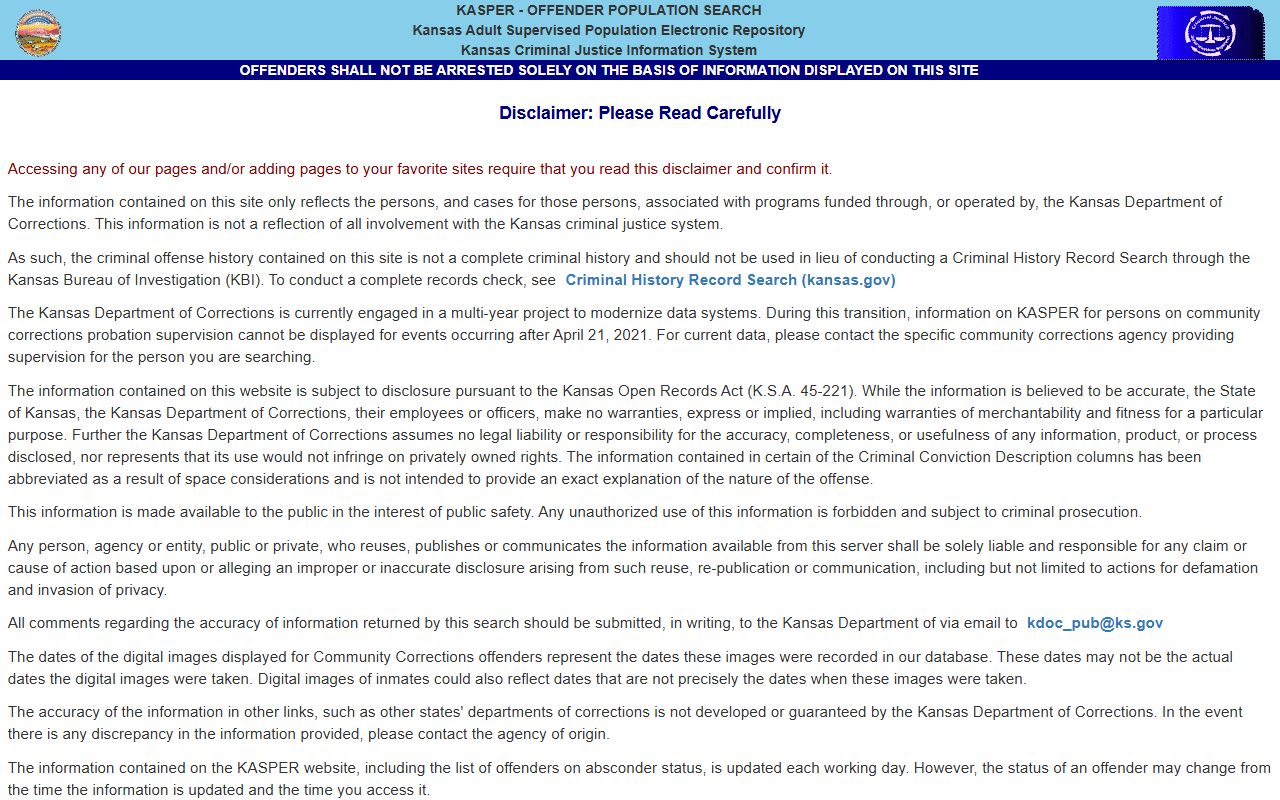
A result should be matched by identifiers and read as a dated KDOC record, not treated as proof that no other case or custody event exists.
Note: A location listed as a parole office means release from prison to supervision, not final discharge from the sentence.
Harper County Parole Office Route
KDOC's current directory assigns Harper County to the Wichita Parole Office. This office route is one of the most useful local distinctions in a supervision search. It serves people under KDOC parole or postrelease supervision. It does not supervise ordinary probation imposed directly by Harper County District Court.
Wichita Parole Office
212 S. Market Street
Wichita, KS
Phone: 316-262-5127
Confirm the office assignment and contact details through the KDOC parole-office directory before relying on them, since coverage and offices can change. A caller should have the KDOC number, full legal name, and the status or supervising-location text shown in KASPER. The office may limit what it can disclose, but it is the correct route for interpreting a Harper County KDOC supervision assignment.
Probation questions stay local. The Harper County District Court lists Court Services at 620-842-3586 and Community Corrections at 620-842-5499. The court file can show which office received the case, the length of supervision, later revocation proceedings, and whether a discharge order was filed.
Harper County Parole Hearings
The Kansas Prisoner Review Board publishes monthly public-comment schedules and offender lists before eligible parole hearings. These are forward-looking lists. They are not release lists and not a name-searchable database of final decisions. The county shown on a list is generally the county of offense, which may not be the person's current residence or proposed return location.
The official public-comment calendar is the place to check each month for current schedules and offender lists.

The calendar can identify an approaching eligibility process, but physical release must be verified later through KASPER movement, the board, and the supervising office.
Under K.S.A. 22-3717, eligibility depends on the sentence, offense date, minimum term, good time, and special rules. Most non-off-grid guidelines sentences for crimes after July 1, 1993 follow a prison term with mandatory postrelease rather than discretionary parole. A listed hearing therefore needs sentence-specific reading.
The board describes three core outcomes. “Parole” means it found the person suitable for release. “Continue” means more deliberation, information, or evaluation remains. “Pass” is a denial for a stated period. Even a grant can precede physical movement because release planning or later action may intervene.
Harper County Absconder Status
An absconder label means the supervision agency reports that it lost contact with the person or alleges failure to comply with supervision. It is not the same as a new conviction. Nor does it prove the person is in the Harper County Jail. KASPER may display the status for a KDOC case, while a court docket may show a warrant, motion to revoke, arrest, or later hearing in a probation case.
Conditions vary by judgment and supervision plan. They can address reporting, travel, treatment, payment, residence, or compliance with court and agency directions. The public record should be used to identify the actual condition and alleged event rather than applying a generic rule. A violation can lead to added requirements, a hearing, revocation, or return to custody, depending on the authority and facts.
If a supervised person returns to a county jail, the new booking event and the underlying supervision matter are still distinct records. Confirm the jail movement with the Sheriff and the legal reason through the court or KDOC. The VINE Inmate Check is useful for a named county-jail detainee, not as proof that parole or probation ended.
Harper County Supervision Discharge
Release from a jail or prison starts the community phase in many cases. Discharge is the stronger endpoint. KASPER can show a “Discharged” status when the KDOC relationship in that record has ended. For probation, the court docket or a filed discharge order is the durable source. Neither record excludes an unrelated case in another jurisdiction.
K.S.A. 22-3722 addresses a later final order or certificate of discharge after satisfactory performance for covered parole and postrelease cases. The date matters beyond simple status. Kansas expungement waiting periods for many qualifying convictions generally run from sentence satisfaction or discharge from probation, community corrections, parole, postrelease, conditional release, or a suspended sentence, not merely from the day a person left a jail.
Keep the sequence clear: board or court decision, physical release or transfer, supervision status, and final discharge. The Harper County released-inmate search and records path explains how the county release record and court file fit around that timeline. If a certified endpoint is needed, request the existing discharge record from the agency or court that issued it.
A complete verification record should preserve the full status label, the agency name, the case or KDOC number, and the date the source was checked. Those details help distinguish an old parole entry from a current one. They also show whether the answer came from a court docket, a KDOC locator entry, or a county custody event. If a record later changes, compare the new entry with the saved status instead of assuming the first result was false.
Harper County supervision can also end in stages. A person may complete a jail term, begin probation, face a later revocation case, and eventually receive a probation discharge. A state prisoner may move from incarceration to postrelease and only later reach KDOC discharge. Each stage has its own record owner. The Sheriff documents the local jail exit, the court documents judicial orders, and KDOC documents its custody and supervision relationship. Asking each office for the event it owns produces a clearer timeline than asking one office to interpret the entire case.
Note: A release date and a supervision-discharge date answer different questions and should not be substituted for one another.