
Harper County Release Records Explained
“Released” describes a custody event, not a verdict. Harper County Jail may record bond, recognizance, completion of a county sentence, probation, dismissal when no other hold remains, or another court-authorized exit. It can also record delivery to the Kansas Department of Corrections, another county, the U.S. Marshals Service, or immigration authorities. Those transfers end Harper County custody but do not return the person to the community. The destination and exact disposition code are therefore as important as the release time.
The Sheriff's record documents physical movement. The Harper County District Court file can explain the order behind it. KASPER, the Kansas Adult Supervised Population Electronic Repository, covers people in KDOC custody or supervision, not every local booking. Kansas VINE covers adult county-jail custody and expressly excludes KDOC state-prison residents. BOP and ICE maintain separate federal systems. No single name search covers them all.
- Time served
- The confinement part identified by the order was satisfied, though other duties may remain.
- Probation
- Court supervision that may replace continued imprisonment.
- Parole
- Conditional release for an eligible indeterminate Kansas prison sentence.
- Discharge
- The end of the KDOC relationship shown in the state record.
How Harper County Custody Ends
A short release label must be read with the court case and destination. Bond generally means an exit from pretrial confinement under court terms. “DOC,” “hold,” or an agency name usually means custody changed hands. Dismissal of one charge cannot overcome a different hold. A booking photo remains tied to the historic intake if retained and does not prove current custody.
| Path | Meaning | Next source |
|---|---|---|
| Bond or recognizance | Community exit under court terms | Court bond order |
| Time served | Ordered jail portion completed | Release sheet and journal entry |
| Probation | Local court supervision | Court Services or Community Corrections |
| KDOC transfer | State custody continues | KASPER after intake |
| Federal transfer | Named federal custodian receives person | BOP, ICE, or federal docket |
Parole and postrelease status mean release from a prison institution into KDOC supervision. “Discharged” is the stronger state endpoint. Neither excludes an unrelated case. Preserve the source, access date, status label, and destination rather than reducing distinct outcomes to the word “released.”
Fields in Harper Release Records
Harper County publishes no online jail data dictionary and does not promise that one public form contains every field. A focused request can identify the existing booking or jail-management record and enumerate the desired parts. The custodian may provide releasable fields, redact protected material, or explain that the field is not retained in that form.
| Field | What it shows |
|---|---|
| Booking identity or number | Connects the event to the correct intake |
| Admission and release date/time | Period of local physical custody |
| Release type or code | Bond, sentence completion, transfer, or another result |
| Releasing authority | Agency or court authority behind movement |
| Destination agency | Community exit versus continued custody |
| Charges, case, and bond | Links the booking to court without proving outcome |
| Booking photograph | Historic intake image if public and retained |
K.S.A. 22-3426 requires covered judgment entries to state convictions, sentences, supervision duration, concurrent or consecutive terms, jail credit, and jail ordered as a probation condition. The court order explains authority and computation. The Sheriff's timestamp better documents the physical event. Both may be needed.
Request Harper County Release Records
The Harper County Clerk publishes the county Kansas Open Records Act channel. Requests may be delivered in person, by mail, or by email. The custodian is at 201 N. Jennings Avenue, second floor, Anthony, KS 67003; Clerk@HarperCountyks.gov; 620-842-5555. Hours are Monday through Friday, 8 a.m. to 5 p.m. Reasonable actual costs may apply, and an estimate can be requested first.
- Give the full name, useful variants, approximate booking dates, and known case or booking number.
- Ask for the existing booking and release record rather than a newly created report.
- Enumerate release date/time, code, authority, destination, bond data, and other needed fields.
- Request the associated booking photo separately and ask for electronic copies in their existing form.
- If access is limited, request the statutory ground and all segregable nonexempt portions.
The county says it will provide records or a written response within three business days. That is a response rule, not guaranteed final delivery. The response can provide records, seek clarification or payment, deny access with authority, or give an expected production date. District Court controls journal entries and docket records; KDOC and federal agencies control their own records.
Kansas Law on Harper Releases
The Kansas Open Records Act begins at K.S.A. 45-215 and favors access subject to exemptions. K.S.A. 45-221 can protect criminal-investigation, juvenile, personal, sealed, expunged, security-sensitive, and other material. Ask for the precise exemption and open portions when a release-sheet field or booking photo is withheld. Do not assume all arrest material is always open or always closed.
Harper County publishes no release-feed retention term. An agency need not recreate a destroyed record. A later miss can reflect retention, spelling, old paper files, a municipal case, or restricted access. Court sealing and expungement also affect public availability. A narrow one-person request for custody verification is more precise than asking the county to create an analysis or broad list.
Find Harper County Released Inmates
Harper County publishes no official current roster, searchable booking archive, 24-hour list, or 72-hour list. Start with custody type. A county-only booking follows VINE, Sheriff, and court records. A Kansas prison sentence follows KASPER. A federal case follows the federal custodian.
- Search the specific person in Kansas VINE and compare identifiers and facility.
- Call the Sheriff at 620-842-5135 and ask whether the final event was community release, transfer, or another booking.
- Review the correct Harper County criminal case for bond, dismissal, sentence, probation, commitment, revocation, or discharge.
- Search KASPER if KDOC custody or supervision is possible, using a KDOC number when known.
- Use BOP, ICE ODLS, and the federal docket when a federal custodian is named.
- Request the release record when dynamic systems disagree or no longer preserve enough detail.
Silence proves little. VINE is not a permanent archive. KASPER excludes county-only bookings. Online court documents depend on access rules and local eCourt history. A transfer may remove a person from one system before intake appears in the next.
No Harper Recent Release Feed
The official Sheriff page gives office identity and a Facebook link but no roster, booking search, released view, archive, photo field, cadence, or retention period. No official jail app was identified. The official Harper County Sheriff page is captured below.
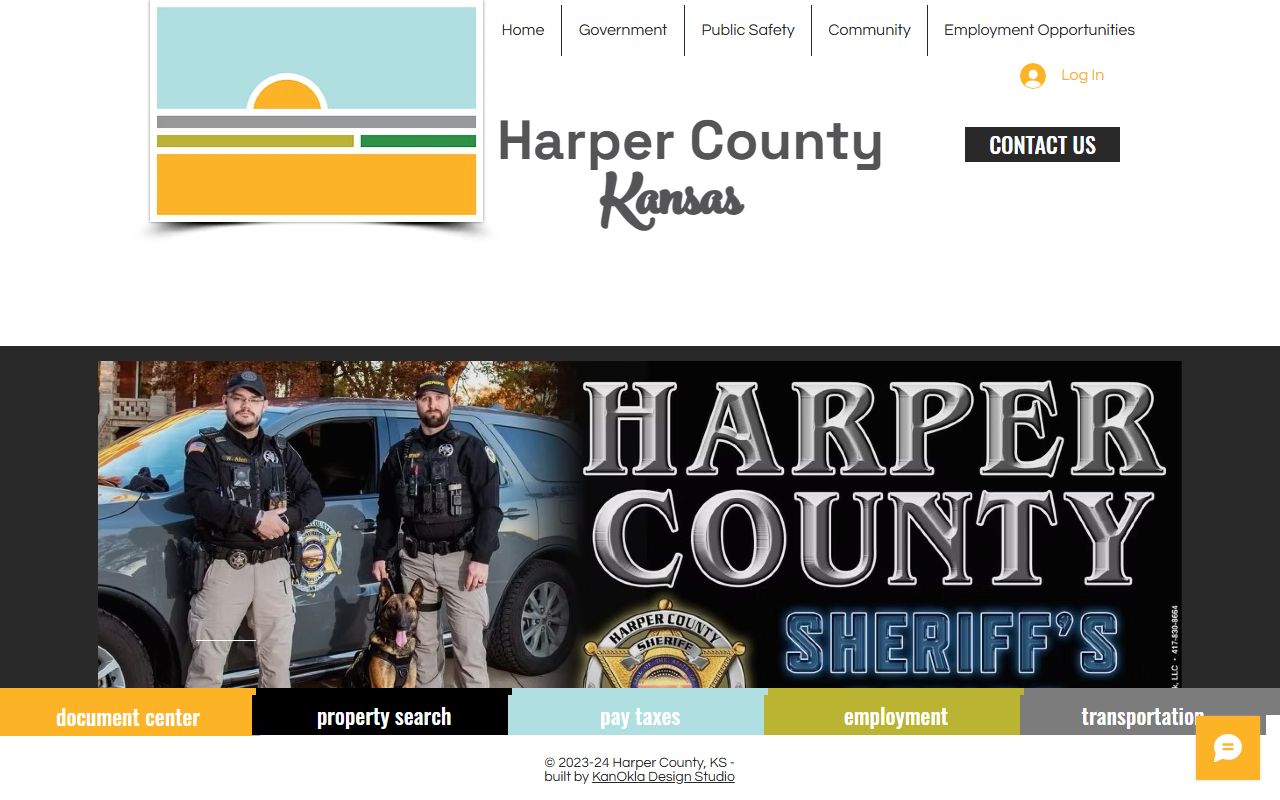
The image supports the local finding that a one-person VINE check, telephone confirmation, KORA request, and court record are the authoritative alternatives. The linked social page may carry agency news, but research did not establish routine releases or photographs there.
KASPER Search for Harper Releases
KASPER covers adults connected to KDOC, not all people booked locally. Search by KDOC number when possible or by full legal name. Compare date of birth, conviction county, case, photograph, and other identifiers. Status choices include “Discharged” and “Discharged-Deceased.” Parole and postrelease mean release from prison into supervision. A correctional-facility location means state custody continues.
| Field | Use |
|---|---|
| KDOC number | Strong person match |
| Exact status | Prison, supervision, absconder, or discharge |
| County and case | Connection to sentencing court |
| Location | Institution or supervision placement |
| Anticipated release date | Projected field, not actual movement |
The official KASPER entry appears below.
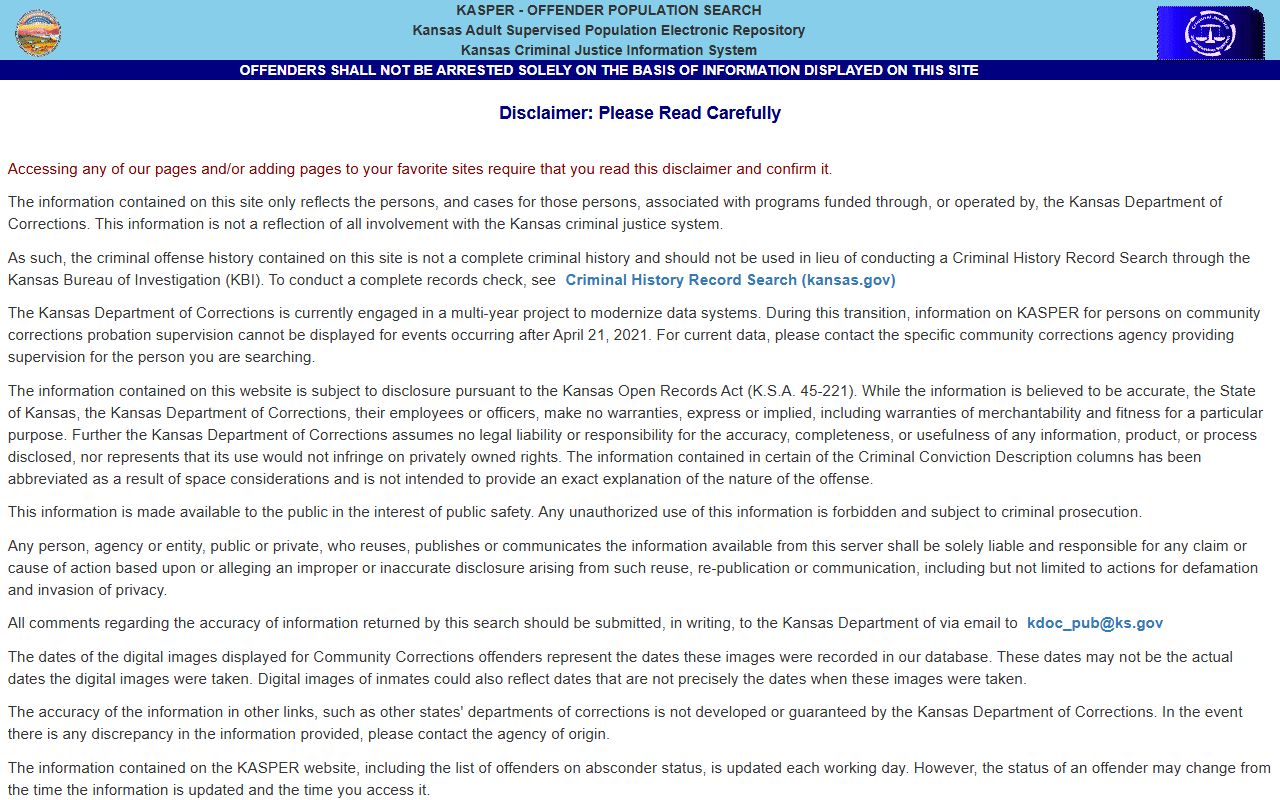
KASPER updates on working days. It also warns that community-corrections probation events after April 21, 2021 are not displayed. Ordinary Harper probation should be checked through District Court and local supervision offices.
Harper Release Orders in Court
Harper County is in the 30th Judicial District. Search the correct criminal case and review the register of actions for bond, dismissal, judgment, sentence, probation, commitment, revocation, termination, or discharge. Obtain the journal entry instead of relying on a short docket label. It explains the judge's order but not the hour staff moved the person.
The official Harper County District Court page provides the local court contacts and docket route shown below.

The captured page connects the local clerk with statewide court access, while the Sheriff remains the source for the jail's physical movement.
An absent online document may predate local eCourt participation, remain available at a courthouse terminal, or be sealed or expunged. It does not prove no case existed. The local page separates District Court, Court Services, and Community Corrections, which answer different questions about the order, probation, and physical release.
Getting Home After Harper Release
Harper County Public Transportation offers general curb-to-curb demand-response service Monday through Friday, 8:30 a.m. to 4:30 p.m., excluding weekends and county holidays. Published round-trip fares are $4 in city, $7 in county, and $20 out of county under 70 miles. Riders should call 620-842-5104 ahead.
The program does not promise jail pickup or coordinate with release processing. It is only a call-ahead option. Confirm the release, pickup point, operating day, trip eligibility, and reservation directly. No official source gives a public release door, waiting area, nighttime procedure, or family pickup rule.
When Harper Release Records Disappear
For many qualifying Kansas convictions, the K.S.A. 21-6614 expungement clock runs from sentence satisfaction or discharge from probation, community corrections, parole, postrelease supervision, conditional release, or a suspended sentence. It does not necessarily start at the first jail exit. Arrest-only expungement follows K.S.A. 22-2410. Final supervision discharge therefore differs from initial release.
A granted expungement generally restricts covered custodians' public disclosure except to authorized recipients. Different waiting periods and excluded offenses apply, so the original case and current law control. An independent old copy presents a separate issue. No verified Kansas rule found in the research guarantees removal from private publication.
Harper Jail History and Releases
A federal Bureau of Justice Statistics inventory from the 1978 jail census identifies a Harper County county jail and reports construction in 1976. This is history only. It cannot establish present capacity, condition, renovations, layout, staffing, or an unbroken facility identity. Current Sheriff information controls current operations.
Old directories also conflict on street rendering. Call before visiting. No source establishes modern release hours, an exit, property-return steps, annual bookings, or capacity. Historical detail cannot fill those gaps.
Harper Release Systems Compared
Kansas VINE reports county-jail transitions. KASPER reports KDOC incarceration, supervision, and discharge. BOP reports federal prison history. ICE ODLS applies to qualifying immigration custody and limited recent releases. A Sheriff destination field links systems when custody transfers.
| Situation | Source | Meaning |
|---|---|---|
| Current local custody | VINE and Sheriff | Person-specific county status |
| Past local movement | Sheriff and court | Physical event and legal basis |
| Kansas prison or supervision | KASPER | State status |
| Federal prison | BOP and docket | Federal status |
| Immigration custody | ICE ODLS | ICE status |
A BOP “RELEASED” result means no longer in BOP custody, not necessarily free of supervision or other custody. An ICE miss is inconclusive. A VINE transfer is not community release. Exact wording prevents these errors.
Harper Release Alerts and Supervision
Kansas VINE is free, confidential, voluntary, and available to the public for participating adult county-jail records. Select Kansas, search by the offered name or identification number, and compare the facility and identifiers. While the custody record remains active, notifications may be registered by phone, email, text, or app. Telephone registration uses a four-digit PIN. When a call arrives, listening and entering the PIN followed by the pound sign acknowledges that event. Email registration does not use the same PIN process.
A notification can concern release, transfer, or escape. It reports what the participating jail sent, not the final result of the criminal case. Transfer may require a new registration with the receiving facility. A person who has already vanished from VINE should be checked through the Sheriff release record and the court file. Kansas VINE does not cover KDOC prison residents, so a failed search for a state prisoner must not be described as proof of release.
KDOC has a separate victim-notification service for people in its facilities or under its supervision. KASPER can show parole, postrelease supervision, conditional release, an absconder label, or discharge. Harper County is assigned to the Wichita Parole Office for qualifying KDOC cases. Ordinary probation imposed directly by District Court follows Court Services or Community Corrections instead. A person can therefore leave Harper County Jail under probation without ever becoming a KDOC parolee.
The Kansas public offender registry is another limited post-release trace for people in statutory registration categories. Registry presence shows a legal registration duty, not current incarceration and not the custody event itself. It does not cover all released people. The Sheriff, court, KASPER, or federal custodian still provides the actual release or transfer evidence.
Harper County Release Facilities
Harper County Jail handles local custody. Kansas prisons hold people committed to KDOC elsewhere. Wichita Parole Office serves qualifying state supervision, while direct probation remains with the court. BOP, ICE, and USMS follow federal paths. The Sheriff record's destination identifies which system comes next.
- Harper County Jail for local releases and transfers
- Kansas Department of Corrections for state custody and discharge
- Wichita Parole Office for KDOC community supervision
- Federal Bureau of Prisons for sentenced federal custody
- ICE / U.S. Marshals Custody for federal detention and transport
A facility name alone does not prove destination. Confirm it in the release transaction.
Preserve a Harper Release Finding
Dynamic records can change after access. Save the full agency name, access date, exact status wording, identifying number, case number, and destination shown. Keep the agency response with its file metadata when a release sheet arrives electronically. A later KASPER update or expired VINE result will then not erase the basis for the conclusion. When two sources disagree, compare their update schedules and ask the office that owns the disputed event. The Sheriff controls the local movement, the court controls its order, KDOC controls state status, and each federal agency controls its own custody record.
Identity matching also requires care. A common name alone is weak. Compare the booking or KDOC number, date of birth when lawfully displayed and needed, conviction county, case, facility, and photograph context. Do not merge two people because one field looks similar. Write down whether a displayed date is scheduled, anticipated, actual, or discharge. Those terms answer different questions.
Finally, ask a narrow question. “What existing record shows this person's final Harper County Jail disposition and destination?” is more useful than asking an office to explain an entire history. If the answer names another custodian, follow that named route. If it reports community release, use the court file to understand continuing bond, probation, or other terms. This method yields a traceable Harper County release finding without treating a live roster, old image, or isolated docket label as the whole record.